


Safety measures for elevators against COVID-19
COVID-19 pandemic has spread all over the world. From the beginning of 2020, step by step, all countries were affected by the virus, and officials took so many kinds of precautions. One by one, countries shut their doors to the outside world, and almost all of them set restrictions in daily life. Government officials invited their citizens to stay at home, and not to go out for a while if not necessary. So, people spent a reasonable time in their homes, but they couldn't prevent millions to get viruses, which caused hundreds of thousands of deads all over the world.
COVID-19 has affected the daily modern lifestyle because of the social distancing rule. The most important protection methods from the virus are to put on masks and watch for the social distance rule. Doctors accepted the minimum secure distance as 1 to 1,5m between every individual. And one of the most affected parts/tools of this rule is public transportation. Because you have to stand in a closed space the virus can spread easily for public transportation. There may be some solutions for a public bus in an example, but elevators! You don't have that much space.
So, elevators carry a high risk for the pandemic. Because there is only a limited and closed space inside a cabin. And so many people have to use them mostly in a limited time. Unfortunately, one infected person can spread the virus to many people without even noticing. One research in March, one infected asymptomatic woman in Heilongjiang China has caused 71 people to get infected after an elevator ride, without even contacting anyone. The research revealed that enclosed and densely used places, like elevators, have the potential to spread the virus very easily.
Today, the pandemic didn't finish, but life has to go on. And we have to deal and live with the virus. So what should we pay attention to while using elevators? What are the most effective precautions? Today we will talk about these important issues.

Potential Risks of Elevators for COVID-19
Elevators are small spaces. According to EN 81-20, Safety Rules for the Construction and Installation of Lifts, the minimum available car area for 1 person is 0,28 m², for 2 persons 0,49 m², and it goes like this. Finally, for 20 persons, it is 3,13 m². So we can understand that all the designings of elevators don’t fit the first rule of COVID-19, social distancing. It is impossible to follow social distance while using elevators normally.
The second important issue is about the control panel or the buttons of the elevators. As we clearly know that the virus spreads via contact. We have to use elevator buttons to send a command to the cabin. This makes buttons of densely used elevators the most potential threat for spreading the virus.
Another threat comes from the air. Researches revealed that coronavirus can hover in the air for a couple of hours, and people who contact them may get the virus. Especially air-conditioning systems radiate the air of a closed space to everywhere. So, the air inside an elevator has the potential of carrying particles that may carry coronavirus which can infect a healthy traveler.
These are the main risks for elevators about COVID-19. So now we will talk about the precautions.
COVID-19 Precautions for Elevators
The main and most useful move for elevators is not to use them if not necessary. Even if the risk has small possibilities, no one can ensure %100 safety, and using alternative ways like stairs would be the safest choice. But you are living or working in a high building, or you are disabled, or you carry a stroller for your baby; you must use the elevator. Here are the effective precautions about elevators;
Every passenger should wear protective masks during elevator travel.
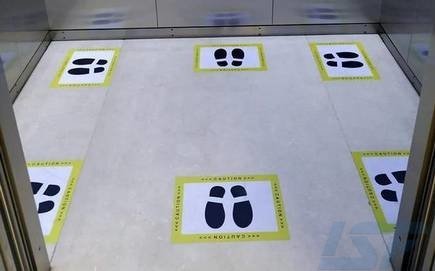
The capacity of people should be reduced. This way, fewer people use a cabin at a time and social distancing may be more possible. But of course, this would cause more traffic, especially densely used places like skyscrapers.
Do not speak in the elevator. Researches show that little respiratory droplets, or aerosols that we radiate while speaking, laughing, or coughing have the potential to spread the virus. So, don’t speak or laugh, and if it is possible, hold your cough or sneeze as much as you can until the end of travel.
People who use a cabin at the same time should stand as far as possible from each other. The best standing points are the corners of the cabin.
New technology command systems can be used in elevators (like voice command), this way contact with buttons may be prevented.
For densely used elevators, an attendant may be responsible for following rules and pushing the buttons. This way, only one person will use the buttons who can also sanitize them frequently. But if there will be an attendant in the elevators, they should wear more protective equipment like N95/FFP2 mask, protective suit, and etc.
If there is no chance to use an attendant, as a low-density elevator in buildings, the management should make the buttons sanitized with chemicals frequently.
The filters of air-conditioning systems should be cleaned or renewed regularly. If the air is not very hot, air-conditioning systems should not be used at all.
In order to prevent human traffic, the speed of door opening and closing can be increased. Also, if it is technically possible, the speed of the elevator can be increased.
Managements should place hand sanitizers on every possible spot like every floor and inside the cabin. So, travelers can use them after pushing the buttons.
These are some crucial, easy but effective precautions that every individual and management should follow. As ISF Elevator Company, we care for our followers’ health. We believe that we will survive these dark days, beat this little evil, and live happily in our daily lives again. If we follow these basic rules, the risk will be lower. For more information and assistance, you can contact us anytime.


