
Elevators Types and Classification - Part Two
In the previous topic, Elevators Types and Classifications – Part One, I indicated that elevators can be classified as follows:
According to the hoist mechanism.
According to building height.
According to building type.
According to elevator Location.
According to Special uses.
I explained some of these classifications and types, and today I will continue explaining other elevator classifications and types as follows:
3- According to building type (continued from the previous topic)
5- Parking Elevators
A- Parking Elevators for Passengers
|
Parking Elevators for Passengers |

Most parking garages have parking elevators for passengers that allow them the convenience of going up or down several levels without the necessity of climbing stairs. Sometimes these elevators have front and rear entry and can be built with several optional features such as key access to certain floors. Most underground garages have parking elevators for passengers.
B- Conventional Parking Elevators
|
Conventional Parking Elevators |

The conventional parking elevators are built to move vehicles to upper or lower levels of the building because of their space-saving feature. With ramps on and off parking, levels consume a lot of space which could be better utilized as parking spaces for vehicles. With the addition of parking elevators, vehicles can be transported up and down as many levels as necessary by taking up only the space required for that vehicle. But maintain the need for attendants to sit in the car, in the elevator, and park it on the floor on which there is space.
C- Auto Car Parking Elevators
|
Auto Car Parking Elevators |

As against cars being driven (on-ramps) or carried (in-car lifts) to different levels in conventional multi-level parking, cars are driven at only one level for parking or retrieval, Cars are parked in steel pallets and a target pallet comes up or down to the driveway level at the press of a button, for parking or retrieval.
Such car parking systems or auto parking systems are also referred to by various other names in different parts of the world, such as “auto-parking”, "stack-parking", "mechanized parking", "mechanical parking", "park mat", “modular parking” etc.
This type can be divided into many different types as follows:
|
Auto Car Parking Elevators Types |

C.1 Square Type
The system arranges many carriers on several intended floors and a lift installed either at both ends or the center goes up and down with vehicles loaded. It is designed so that vehicles can be parked and retrieved by moving a pallet horizontally. It is safer than other systems and the cutting-edge mechanical car parking system and operates very smoothly. It is fit for installation in a narrow and long-shaped lot or underground of a building.
C.2 Level Type
The system is designed so that car parking lots move both horizontally and circular to park vehicles. Many carriers are arrayed in more than one row in the car parking lot and the system works by moving both horizontally and circular the carriers at both ends of level.
C.3 Rotary Type
A system that two sprockets as a set are fixed; one onto an upper part of a structure and the other onto a lower part and then a cage hung to an attachment of a special chain circulates with vehicles loaded. This system with simple operation and low installation cost requires a small lot for installing equipment and may be divided into subsystems as follows:
1. Bottom entering type: A type that cars are parted and retrieved at the bottom of parking requirements.
2. Middle entering type: A type that cars are parked and retrieved in the middle of parking requirements.
3. Top entering type: This type that car is parked and retrieved at the top of parking requirements.
C.4 story Type
A system is featured by using all parking lots on the first floor as the place for car parking/retrieval. Carriers are arranged on two levels, where cars are parked through both vertical and horizontal movements. With a short construction period and easy installation, it is fit for household use or a small-scale parking lot.
C.5 Puzzle Type
The carriers are arranged on 3-storey and more than 3-story, a specific carrier moves both vertically and horizontally to and from more than one car entrance on the same level, It is an economical system, has safe structures, and is designed to utilize space efficiently to install parking equipment. As there are few laws and regulations on this system and the installation period is short. it is fit for utilizing an idle lot in residential areas.
C.6 Turn Table
A turntable is equipment that changes directions itself utilizes efficiently a limited space.
The turntable installed in front of parking equipment provides drivers with convenience and safety.
C.7 Elevator Type
This System is arranged On multi-levels and designed to automatically Carry and park Cars by a lift and a Carrier installed inside parking lots A pallet for parking is built-in independently on each level, that is Carried by a Cage from parking lots to the lift that moves Vertically to an entrance/exit. This System one of the most Up-to-date mechanical Car parking Systems, is featured With Speedy parking/retrieval, is widely installed In a City area, and is fit for a large Scale Car parking equipment that can maximize the Utilization of a limited parking space.
C.8 Lift Traverser Type
This is a full automatically mechanical car parking system that minimizes the time for parking/retrieval by the simultaneous movements, both horizontally and vertically, of a car lift. As the utilization of both parking space and floor space can be maximized and easy forward parking/ retrieval of vehicles is possible from any moving lane, and the convenience of the user can be maximized. The noise level is low and the durability of the car bay is semi-permanent. The scale of car parking can be proportionally balanced and properly coordinated with the building's shape.
C.9 Cart Type
This is a multi-leveled car parking system and is designed to park vehicles into each parking lot by conveying vehicles automatically with both an up-and-down lift and a parking cart. The carts independently installed on each parking level can retrieve vehicles from parking lots, and more than one lift move simultaneously for car parking/retrieval. This is one of the most up-to-date mechanical parking systems with speedy car parking/retrieval and fits a large scale of car parking that can maximize the utilization of the underground space by installing many rows of carts in the underground.
6- Commercial Elevators
A- Commercial passenger elevators
|
Commercial passenger elevators |

A passenger elevator is designed to move people between a building's floors. Passenger elevators capacity is related to the available floor space.
B- Freight elevators
A freight elevator, or goods lift, is an elevator designed to carry goods, rather than passengers. Freight elevators are generally required to display a written notice in the car that the use by passengers is prohibited (though not necessarily illegal), though certain freight elevators allow dual use through the use of an inconspicuous riser. Freight elevators are typically larger and capable of carrying heavier loads than a passenger elevator, generally from 2,300 to 4,500 kg. Freight elevators may have manually operated doors, and often have rugged interior finishes to prevent damage while loading and unloading. Although hydraulic freight elevators exist, electric elevators are more energy-efficient for the work of freight lifting.
Freight elevators include the following classes:
|
Freight elevators Classes |

Class A: General Freight Loading
Where the load is distributed, the weight of any single piece is not more than 1/4 the capacity of the elevator and the load is handled on and off the car platform manually or using hand trucks.
Class B: Motor Vehicle Loading
The freight elevator is used solely to carry automobile trucks or passenger automobiles up to the rated capacity of the elevator.
Class C1: Industrial Truck Loading
A four-wheeled vehicle may be used to load and unload the elevator. The combined weight of the vehicle and the load cannot exceed the rated capacity and may be rolled onto the platform as a single unit.
Class C2: Industrial Truck Loading
During loading and unloading, the max load on the platform may be up to 150% of the rated capacity. This enables you to use a forklift to load a car with freight weighing up to the rated capacity.
Class C3: Other forms of Industrial Truck Loading
During the loading and unloading process, the rated capacity must never be exceeded.
C- Commercial Dumbwaiter
|
Commercial Dumbwaiter |

They are an economic solution for moving material from floor to floor in a multi-level commercial environment. They can carry loads up to 750 lbs.
Commercial Dumbwaiter is used to Save manpower, save space, save time, save energy and help avoid workplace injuries.
Typical materials handled in a commercial environment can be Food, Dishes & Cutlery, Documents, Clothing, Carts, or Shoes.
Commercial Dumbwaiter can have one of the following types of configurations:
|
Commercial Dumbwaiter Configurations |

Forth: Elevators classification according to elevator location
A- Outdoor Elevators
Common types of outdoor elevators are cargo elevators, platform elevators, and incline and vertical elevators.
A.1 Observation elevator
|
Observation elevator |

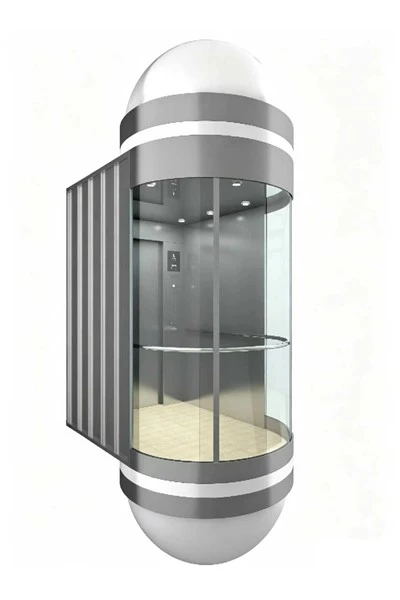
The observation elevator puts the cab on the outside of the building. Glass-walled elevator cars allow passengers to view the cityscape or the building’s atrium as they travel. By eliminating the hoistways, the observation elevator also offers owners, architects, and builders valuable space-saving advantages.
A.2 Incline Elevators
|
Incline Elevators |

Outdoor elevators built on an incline can also be used to transport passengers or goods. Incline elevators are most often recognized as passenger elevators called ski lifts. However, outdoor elevators that move cargo on an incline are generally constructed with a conveyor belt and are most often seen when loading cargo on ships and some types of aircraft.
A.3 Platform Elevators
|
Platform Elevators |

While it is possible to use platform elevators indoors they are generally classified as outdoor elevators because that is where they are most often used. Platform elevators usually are not enclosed by having a have a fence or gate running around the perimeter to keep cargo from slipping off during transport. Platform elevators usually use a system of pulleys as the working mechanism. Outdoor elevators consisting of a platform are most often used at new construction sites but they can also be used for such things as elevating workmen renovating the façade of a building or washing windows on a high-rise.
A.4 Freight Elevators
|
Freight Elevators |

Freight elevators are almost always outdoor elevators even though some smaller versions are designed for indoor use such as those used in warehouses. They are most often extremely heavy-duty and can facilitate a great amount of weight. This type of elevator can either be on an incline or vertical, but will most often be industrial grade to accommodate those heavy loads. In fact, the first type of elevator which comes to mind when thinking of outdoor elevators is actually freight elevators.
B- Indoor elevators
All elevators installed inside a building usually need hoistways and pits.
Fifth: Elevators classification according to special uses
A- Handicap Elevators
|
Handicap Elevators |

In reality, any type of elevator that can assist a handicapped person is going up and down various levels of the building could be considered a handicap elevator. However, specific types of elevators are manufactured with handicapped persons in mind. A good example of this would be a wheelchair lift that gets a handicapped person in and out of vans. The lift comes out of the sliding doors and descends to allow the wheelchair on the platform. Then the lift is raised and backs into the vehicle. Most city buses have this type of handicap elevators installed on them, but they are also manufactured for privately owned vehicles as well. Most handicap elevators within a home are electric elevators, but some are pneumatic vacuum models as well and operated by air pressure. Stairway lifts are also considered to be a type of handicap elevator and this type can either be installed on a straight stairway or a curved staircase.
B- Grain Elevators
|
Grain Elevators |

A grain elevator is a tower containing a bucket elevator, which scoops up, elevates, and then uses gravity to deposit grain in a silo or other storage facility. They can be classified as either “country” or “terminal” elevators, with terminal elevators further categorized as inland or export types. Operations other than storage, such as cleaning, drying, and blending, often are performed at elevators. The principal grains and oilseeds handled include wheat, corn, oats, rice, soybeans, and sorghum.
C- Double-deck elevator
|
Double-deck elevator |

Double-deck elevators save time and space in high-occupancy buildings by mounting one car upon another. One car stops at even floors and the other stops at the odd floors. Depending on their destination, passengers can mount one car in the lobby or take an escalator to a landing for the alternate car.
D- Sky Lobby
|
Sky Lobby |

In very tall buildings, elevator efficiency can be increased by a system that combines express and local elevators. The express elevators stop at designated floors called sky lobbies. There, passengers can transfer to local elevators that will take them to their desired floor. By dividing the building into levels served by the express elevators, the local elevators can be stacked to occupy the same shaft space. That way, each zone can be served simultaneously by its own bank of local elevators.
F- Limited use / limited application (LU/LA)
|
Limited use / limited application (LU/LA) |

The limited-use, limited-application (LU/LA) elevator is a special-purpose passenger elevator used infrequently and is exempt from many commercial regulations and accommodations. For example, a LU/LA is primarily meant to be handicapped accessible, and there might only be room for a single wheelchair and a standing passenger